Vyberte svou polohu
Pro co nejlepší zkušenost s těmito webovými stránkami prosím zvolte polohu a jazyk
Pro co nejlepší zkušenost s těmito webovými stránkami prosím zvolte polohu a jazyk

Organizations are navigating a landscape defined by rapid technological advancement, evolving regulations, and heightened sustainability expectations. Barcode labeling is a critical part of fostering efficiency, compliance, and transparency—connecting physical products with digital networks to streamline operations and strengthen the supply chain.
Across industries, the merging of trends such as label print automation, RFID adoption, and the shift from 1D to 2D barcodes is reshaping how businesses manage data and deliver value. Regulatory mandates and sustainability goals add further complexity, requiring agile and scalable solutions.
Is your labeling system prepared for what’s next? Evaluating your current capabilities is the first step toward staying ahead of these changes.
In this blog, we’ll explore the barcode labeling trends shaping 2026, what they mean for your business, and how your organization can proactively adapt.
Prefer a quick overview? Here are the key takeaways:
Staffing shortages and skills gaps are pressing on operations everywhere, making consistency and accuracy in labeling even more critical. Manufacturers are embracing automation to eliminate repetitive tasks, prevent mislabeling, and keep lines moving—especially as labeling volumes increase and product variations diversify. At the same time, integrating with WMS, MES, and ERP systems is becoming the norm, turning labeling into a real-time, data-driven process rather than a manual one-off print job.
Automation reduces human error, ensures compliance, and speeds up throughput. In industries with strict regulations, a mislabeled product can trigger rework, waste, or even recalls. Automated printing from your business systems removes the guesswork, applies the correct templates, and ensures data is pulled at print time. The result is labels that reflect the latest information, lot numbers, expiration dates, and regulatory statements.
As staffing ebbs and flows, automation is a must for resilient operations. When labeling is automated, you get repeatable accuracy and reliable performance during peak demand.
RFID has matured from pilot projects to mainstream deployments. Retailers—including Walmart, Macy’s, Nordstrom, Belk, and Dillard’s—have expanded RFID mandates to improve inventory accuracy, omnichannel fulfillment, and loss prevention. In pharmaceuticals and medical devices, RFID supports traceability, chain-of-custody, anti-counterfeiting, and regulatory compliance. Food & beverage and agriculture use it to track inventory and perishables, environmental conditions, and origin.
RAIN, a global standard for passive Ultra-High Frequency (UHF) RFID technology, has made adoption easier by ensuring interoperability among tags and readers. Combined with labeling software integration, businesses can encode, print, and manage RFID tags alongside barcodes in a single, streamlined process.
RFID enhances real-time visibility and supply chain transparency. You get faster inventory counts, better accuracy, and improved replenishment decisions. It enables item-level tracking across complex networks for detecting inventory loss, confirming authenticity, and supporting regulatory reporting without manual scans at every step.
When label design software allows you to implement both barcode scanning and RFID technology to capture data, processes stay simple and training requirements are low.
GS1 standards are pushing 2D adoption by 2027 to carry more product data and create better digital experiences, making 2026 a key year for adoption. Retail is moving toward 2D for enhanced product information and smarter checkout. On the manufacturing floor and in life sciences, 2D supports unit-level traceability and compact labels without sacrificing the amount of data it holds.
2D barcodes carry more data than traditional 1D barcodes. They support batch/lot, expiration date, serial numbers, and links to digital content. This means you can connect physical products with digital experiences: product pages, sustainability disclosures, recall instructions, or regulatory documents. In healthcare, 2D barcodes help ensure the right product reaches the right patient with the right documentation.
As long as your scanner supports the new barcode symbology, everything else in your labeling process remains unchanged.
Regulations are evolving across retail, life sciences, and food safety. Initiatives like GS1 Digital Link and milestones such as Sunrise 2027 are guiding the transition to 2D barcodes in retail environments. In healthcare, digital labeling continues to evolve as global regulators increasingly support QR codes. In food, allergen declarations and nutrition labeling are under greater scrutiny, with expectations for clarity and accessibility.
Sustainability initiatives are also rising. Increasingly, consumers expect brands to provide transparent packaging and recycling instructions, reduce waste, and support a circular economy. Barcode labels are an easy avenue to communicate sustainability information.
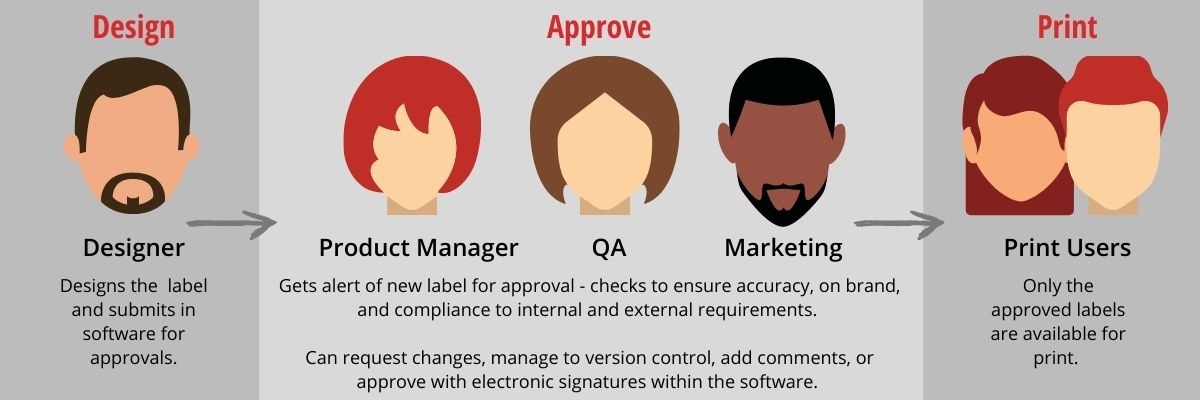
Non-compliance risks fines, recalls, and reputational damage. Regulations can change quickly and operating across multiple countries magnifies the challenge. A flexible label management system helps you adapt quickly without starting from scratch every time a rule changes, or a new rule is introduced.
We’re constantly improving: Check out what’s new in the latest TEKLYNX software version.
Retail, manufacturing, food & beverage, life sciences, and other sectors are adopting similar labeling technologies to overcome shared challenges:
As capabilities converge—automation, RFID, 2D barcodes—solutions or functionality designed for one industry often translate well to others.
You don’t have to reinvent the wheel. Proven practices from adjacent industries can help you too. Retail item-level RFID can advise medical device traceability. The strictness of allergen labeling in the food industry can strengthen consumer communication and ingredient transparency in cosmetics. Manufacturing MES or ERP integrations can help warehousing & distribution improve order accuracy and speed.
Barcode labeling trends in 2026 are clear: automation is becoming the standard, RFID adoption is accelerating, 2D barcodes are becoming more popular, and regulatory and sustainability expectations are intensifying. Competitive organizations recognize labeling as a strategic advantage, helping them boost throughput, adapt quickly to change, and accelerate time to market.
By aligning barcode labeling trends with strategy, businesses can streamline processes, enhance traceability, and build resilient supply chains. At TEKLYNX, we help organizations anticipate changes and turn disruption into opportunity. We make it happen through:
Whether you’re transitioning to 2D barcodes, piloting RFID, or standardizing label templates across global locations, we’ll meet you where you are and guide you in your next steps. Request a review of your current labeling process and let’s build a plan for the future together.
Doug Niemeyer is the President & General Manager at TEKLYNX Americas. He leverages his 25+ years of sales & marketing experience in technology and leadership to help grow the business. His passion for leadership, insatiable curiosity, and competitive spirit help to drive success, encourage progress and development while ensuring teams hold positive customer experiences in the highest regard, all with the purpose of helping companies barcode better. When he is not working you can find him in a gym, on a field or golf course playing or coaching.
Today, companies across the supply chain face a mix of challenges—from unpredictable demand and labor shortages to rising operational costs and heightened customer expectations. One of the more pressing issues is the widening gap in staffing, which impacts productivity, accuracy, and overall efficiency across logistics and fulfillment operations. In this blog, we’ll take a closer look at how automated labeling helps fill staffing gaps and supports a more flexible, layered workforce.
READ MORE
The retail and supply chain landscape is on the verge of a monumental shift. By 2027, the familiar 1D barcode will make way for the data-rich 2D barcode, a transition driven by the global Ambition 2027 initiative, known as Sunrise 2027 in the United States (US).
READ MORE
This blog will highlight how businesses can optimize labeling practices to align with the triple bottom line framework. Companies can drive ethical, sustainable, and profitable growth by focusing on the interconnected areas of people, planet, and profit.
READ MORE© Copyright 2026 TEKLYNX CORPORATION SAS. Všechna práva vyhrazena.
What do you think? Leave us a comment.
Comments will be reviewed and are subject to TEKLYNX’ comment policy. Your email address will not be published publicly.