Choose Your Location
Please select your location & language for the best website experience

Manufacturers today operate within complex, global supply chains—often specializing in one product, process, or market, while relying on a broad network of contract manufacturers, suppliers, warehousing providers, and distribution specialists.
Across this extended network, labeling is the common language that ensures every step in the supply chain works together. From incoming materials to finished goods, accurate and standardized labels are essential for traceability, compliance, and operational efficiency.
For manufacturers with multiple upstream suppliers, supplier labeling isn’t just an operational detail—it’s a strategic advantage. When supplier labels are inaccurate, inconsistent, or outdated, the downstream consequences ripple quickly across operations, inventory, and production schedules.
In this blog, we'll explore:
Without a unified supplier labeling strategy, manufacturers often end up managing a hodgepodge of label files, data, and software solutions, many of which were never designed to scale across a modern supply chain network.
Some manufacturers share label files or spreadsheets with suppliers for printing. Every update, whether driven by a compliance change, packaging update, or customer requirement, must be manually re-sent and validated. This approach is time-consuming and introduces significant risks of using outdated or incorrect data.
Other manufacturers might be managing a mismatched software environment, leveraging different brands and versions of labeling software with each supplier. This often happens organically over time, with little long-term planning. The result is inconsistent label formats, limited visibility, and high administrative overhead for IT and operations teams.
Custom solutions may initially solve a specific problem, but they're expensive to maintain and difficult to keep compatible with modern technology. As requirements evolve like cloud adoption, cybersecurity standards, and regulatory compliance, custom systems often struggle to keep pace.
All three supplier labeling scenarios can lead to errors and inaccurately labeled products, which can quickly turn into costly supply chain disruptions.
Inventory is the heartbeat of manufacturing. Even small labeling errors can cause serious production delays.
Incorrect labels, such as the SKU, that aren't caught early can lead to inventory discrepancies that delay production.
When automatic identification is impossible, meaning barcodes can't be scanned due to bad labels; employees are forced to manually identify products. This slows operations down and increases the risk of human error.
Errors discovered after receipt often mean relabeling inventory or returning products to suppliers which wastes time, labor, and transportation costs.
Over time, these inefficiencies add up, requiring more time and labor to handle incoming inventory.
A unified supplier labeling system is a centralized system that standardizes labeling across the supply chain, ensuring suppliers generate consistent, accurate, and compliant labels. It replaces manual processes with integrated technology to enhance traceability and reduce errors.
Here's how it works:
Centralized label management, complete control
Smart label templates are designed and maintained in-house. Any changes such as regulatory updates, must pass through a label approval process before they're made available for printing. Only approved label templates can be printed.
Secure, web-based supplier access
Suppliers can access labels with a username and password through a secure, browser-based portal. No local software installations or sending files back and forth required. Each supplier only sees the label templates assigned to them, protected by role-based user permissions.
Real-time data, all the time
Seamless integration with ERP, WMS, MES, or other business systems provides accurate, real-time data for every label printed. This eliminates outdated spreadsheets and manual data entry.
Full visibility and traceability
Every label print job, whether it be internal or external, is tracked, and every revision is logged. Detailed reporting sets you up for success and supports audits, compliance requirements, and continuous improvement initiatives.
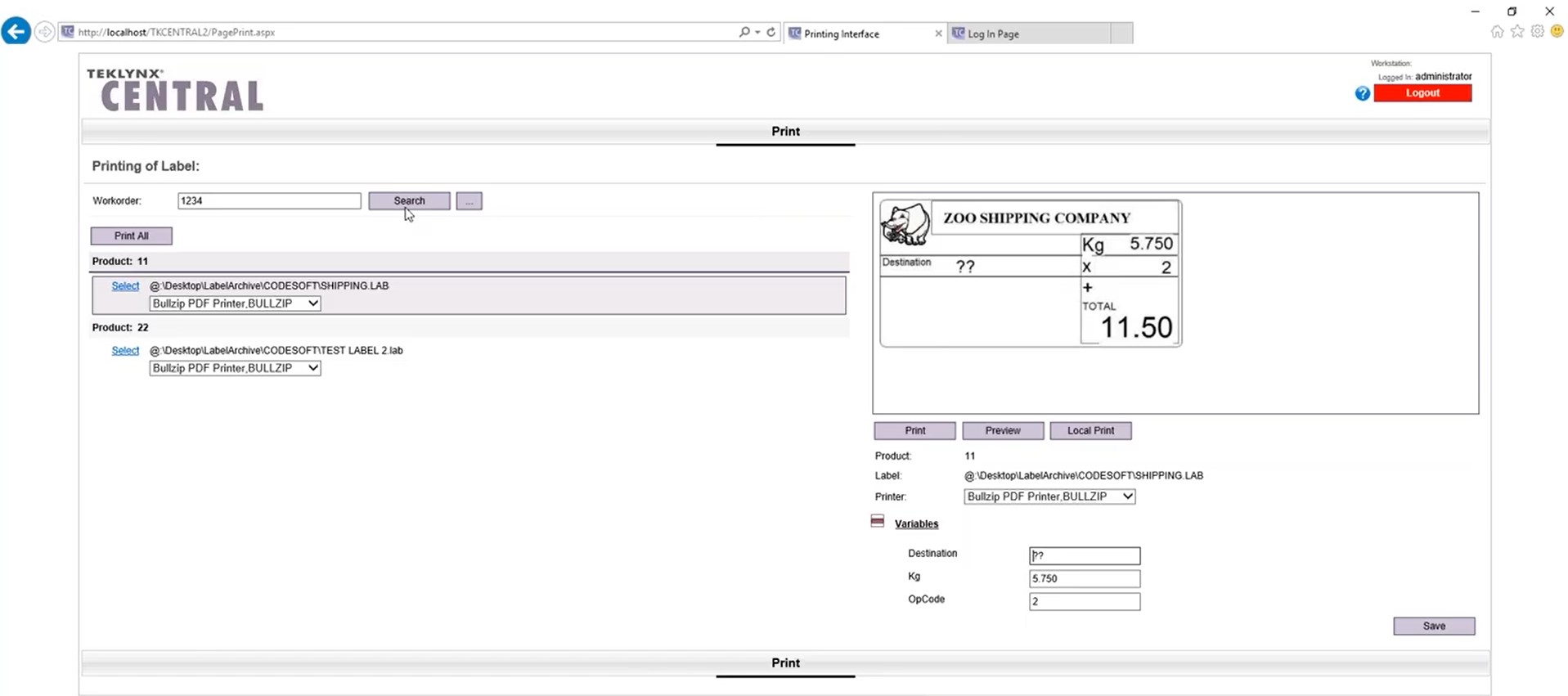
Flexible deployment
The entire supplier labeling system is centrally managed by your company but can be deployed on-premises, in the cloud, or in a hybrid environment, giving supplier manufacturers the flexibility to align with IT strategy and security requirements. Supplier web-based portals can even be branded with your company's logo for a seamless experience.
Implementing a centralized supplier labeling platform delivers measurable results across operations, compliance, and IT. Other benefits include:
Perhaps most importantly, a unified supplier labeling system gives manufacturers confidence and control in an increasingly complex supply chain environment.
The most effective way to modernize supplier labeling is with a unified, label management system—one that brings label design, approval, print automation, and supplier access together in a single solution. That solution is TEKLYNX CENTRAL.
TEKLYNX CENTRAL is an all-in-one label management solution that enables manufacturers to:
With proven scalability and global deployment capabilities, TEKLYNX CENTRAL helps manufacturers simplify supplier labeling, reduce errors, and build more resilient supply chains.
If supplier labeling errors are slowing you down, or if your current approach can't keep up with modern requirements, it may be time for a unified solution.
Talk with a supplier labeling expert at TEKLYNX today to learn how CENTRAL can streamline your supplier network and help your organization barcode better.
Ready to learn more? Get in touch with a supplier labeling expert at TEKLYNX today.
Anthony Bieniewski is the Operations and IT Manager at TEKLYNX. Anthony uses his 15+ years of experience in IT infrastructure and security to continue to move TEKLYNX forward with efficient and secure processes and tools. He also leverages that experience in mentoring and coaching TEKLYNX’s support team so that they can continue to pursue best practices when helping our customers barcode better.
Inefficient label printing leads to wasted materials, lost time, higher costs, and added environmental impact. In this blog, we’ll discuss how to eliminate waste in label printing by showing you five basic steps to optimize your labeling environment with lean labeling practices.
When it comes to improving operational efficiency, manufacturers regularly review key performance indicators (KPIs) like cycle time, on-time delivery, and customer return rate. Barcode labeling and enterprise label management play a key role across many operational KPIs.
READ MORE
A common labeling challenge I’ve been hearing recently is the need to move toward a paperless label approval process. Instead of printing out sample labels, physically delivering them to each person in the approval process, and returning to the label design software to implement changes, companies are looking to digitally transform this process and make label approval paperless.
READ MORE© Copyright 2026 TEKLYNX CORPORATION SAS. All Rights Reserved.
What do you think? Leave us a comment.
Comments will be reviewed and are subject to TEKLYNX’ comment policy. Your email address will not be published publicly.